Web3 News.
The latest in Web3, decoded, original analysis, no hype.
 Web3
Web3
A Zeroed Signature Drained $9M From Bonzo Lend
An attacker deposited 250 SAUCE tokens worth a few dollars, pushed a price update with an empty signature that Supra's Hedera oracle verifier accepted, and borrowed $9.05 million against it. The whole thing took about eight seconds. Hedera's network TVL fell nearly 40% in a day.
 Web3
Web3
Aavenomics 3.0 Routes 100% of Revenue to the Aave DAO
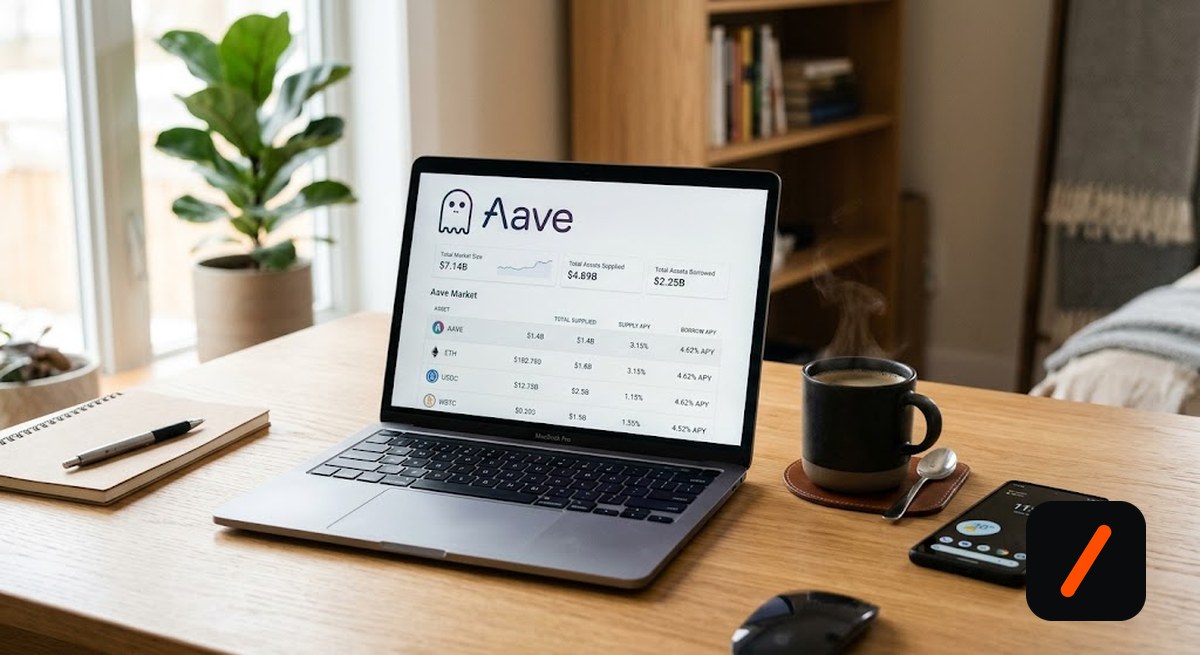
Aave unveiled Aavenomics 3.0, hardcoding its token buyback at the protocol level and routing 100% of revenue from the protocol, the GHO stablecoin, and ecosystem products to the DAO treasury, while expanding lending and GHO onto the high-speed Monad chain.
 Web3
Web3
Summer.fi Loses $6M in a Morpho Flash-Loan Exploit
An attacker drained about $6M from Summer.fi's Lazy Summer Protocol vaults by taking a flash loan through Morpho to inflate the vaults' accounting, then redeeming the overstated balance for profit. The SUMR token fell more than 18% as DeFi's worst exploit year continues.
 Web3
Web3
Aave in Talks to Sell Kraken 15% Stake at $385M
Aave is reportedly in talks with exchange Kraken over a roughly 15% stake valuing the DeFi lending protocol near $385M, a deal that would fuse a centralized exchange with the biggest on-chain money market and blur the DeFi–CeFi line.
 Web3
Web3
Wall Street's Tokenized Deposit Network Takes On Stablecoins
JPMorgan, Citi, Bank of America, and Wells Fargo are building a shared tokenized-deposit network through The Clearing House to move bank money on-chain and counter the trillion-dollar stablecoin boom, with a launch targeted for the first half of 2027.
 Web3
Web3
Tokenized Real-World Assets Cross $30B as Institutions Pile In
On-chain tokenized real-world assets surpassed $30 billion in June 2026, driven by products like Ondo's OUSG on Aave and BlackRock's BUIDL fund, marking the clearest sign yet that institutional capital is using DeFi rails for real yield.
 Web3
Web3
Solana's Alpenglow Kills Proof of History for 150ms Finality
Solana's Alpenglow upgrade, live on a community test cluster and approved by 98% of validators, replaces TowerBFT and Proof of History with new Votor and Rotor protocols to cut finality from about 12.8 seconds to roughly 100 to 150 milliseconds.
 Web3
Web3
Ethlabs: A New Nonprofit R&D Lab for Ethereum Scaling
Ethlabs is a new independent nonprofit research lab launched by five former Ethereum Foundation researchers, focused on faster finality, more mainnet capacity, and institutional-grade Ethereum infrastructure, a sign the network’s R&D is spreading beyond a single organization.
 Web3
Web3
NFT Paris Is Canceled. The NFT Hype Cycle Is Over
NFT Paris and RWA Paris were canceled for 2026 after four editions, a blunt signal that the NFT hype era is over even as the technology quietly survives in gaming, identity, and tokenized assets.
 Web3
Web3
Tokenized Stocks Hit Records as the DTCC Goes Live
Tokenized stock trading blew past records this year, with Solana volumes topping $10B on demand for tokenized SpaceX shares, as the DTCC begins facilitating tokenized production trades in July 2026.
 Web3
Web3
DeFi's worst quarter: 83 hacks, $755M gone, TVL down 37%
DeFi just logged its most-hacked quarter on record by incident count, 83 exploits and $755M stolen in Q2 2026, as total value locked fell 37% for the year, with only real-world-asset protocols growing.
 Web3
Web3
Vitalik's 'Lean Ethereum' roadmap resets the L1 endgame
Vitalik Buterin laid out a multi-year “Lean Ethereum” roadmap to simplify and harden the base layer, prioritizing a leaner protocol, faster finality and quantum resistance over piling on features.
 Web3
Web3
Ethereum's Pectra upgrade goes live on mainnet
Ethereum's Pectra upgrade is now live on mainnet, combining Prague and Electra changes to bring account-abstraction features to ordinary wallets, higher validator stake limits, and more blob throughput for cheaper Layer 2 transactions.
 Web3
Web3
Aave Chan Initiative Winds Down After Governance Rift
The Aave Chan Initiative, one of DeFi's most influential governance service providers, is winding down operations after a rift with Aave Labs. Its exit exposes the fragile economics of the professional delegates that quietly run major DAOs.
 Web3
Web3
Ethereum opens an institutional 'front door'
On July 1 the Ethereum ecosystem launched Ethereum Institutional, a neutral nonprofit 'front door' for governments and enterprises, alongside a new R&D lab, Ethlabs, and a policy guide from the Ethereum Foundation aimed squarely at the public sector.
 Web3
Web3
BlackRock Listing Ethena's USDe Signals a Stablecoin Shift
BlackRock moving to list Ethena's USDe marks Wall Street embracing a crypto-native synthetic dollar, as stablecoins emerge as DeFi's clearest product-market fit and founders pivot from speculative tokens to institutional infrastructure.
 Web3
Web3
Litecoin's LitVM Brings ZK Smart Contracts to LTC
Litecoin is entering programmable Web3 through LitVM, a zero-knowledge Layer 2 that lets developers build Ethereum-compatible apps on top of Litecoin without touching its base layer, with a testnet that has already processed over 75 million transactions.
 Web3
Web3
Summer.fi halts vaults after a $6M flash-loan hack
DeFi protocol Summer.fi paused its Lazy Summer vaults after a flash-loan attack drained about $6M by manipulating the USDC vault's accounting, briefly spiking a displayed APY past 2 million percent. Its SUMR token fell over 18%, and the multichain setup made the blast radius bigger.
 Web3
Web3
Tokenized Real-World Assets Surge Past $32 Billion
On-chain real-world assets have grown to roughly $32 billion, with tokenized equities up 145% to a record $3.86B, as traditional finance moves real value onto blockchains without a federal law.
 Web3
Web3
Aave v4 Rebuilds DeFi Lending on a Hub-and-Spoke Model
Aave v4 introduces a Hub-and-Spoke architecture that lets anyone spin up customizable lending markets without fragmenting liquidity, with launch gated on the results of multiple audits.
 Web3
Web3
EigenLayer Becomes EigenCloud and Routes Fees to Buybacks
EigenLayer rebranded its restaking protocol as EigenCloud, spanning data availability, off-chain compute and dispute resolution, and proposed ELIP-12 to route 100% of EigenCloud fees into EIGEN token buybacks.
 Web3
Web3
Hyperliquid's $645M Unlock Meets a Bigger Buyback Fund
Hyperliquid released about 9.92M HYPE, worth roughly $645M, to core contributors on July 6, but its buyback fund already holds about 4.6 times that. The perp DEX now handles around 70% of on-chain perpetual futures volume.
 Web3
Web3
Uniswap Becomes the Native AMM for Robinhood Chain
Robinhood launched its own Ethereum layer-2 network, Robinhood Chain, on July 1 with Uniswap wired in as the native automated market maker, putting DeFi's biggest exchange directly inside a mainstream broker's tokenized-asset platform.
 Web3
Web3
BNB Agent Studio Deploys Onchain AI Agents Fast
BNB Chain and AWS launched BNB Agent Studio, a platform that turns a single prompt into an autonomous onchain AI agent with its own wallet in about 15 minutes, pushing the AI-plus-Web3 convergence forward.
 Web3
Web3
Crypto wallets and self-custody, explained
A crypto wallet is your identity and account in Web3: a pair of cryptographic keys that let you hold assets and sign transactions yourself, without a bank or platform holding them for you. Self-custody means you control the keys, which means total ownership and total responsibility, no password reset if you lose them.
 Web3
Web3
Smart contracts, explained: code that runs itself
A smart contract is a program stored on a blockchain that runs exactly as written when its conditions are met, with no company able to alter or stop it. It replaces a trusted middleman with code, powering everything in Web3 from token swaps to lending to NFTs, and it is only as safe as the code it is written in.
 Web3
Web3
DAOs, explained: can a company run on code?
A DAO, decentralized autonomous organization, is a group that coordinates and controls shared funds through smart contracts and token-holder voting instead of a traditional management hierarchy. It promises transparent, member-owned governance, and in practice wrestles with voter apathy, whale dominance and the limits of running an organization on-chain.
 Web3
Web3
Stablecoins, explained: crypto’s quiet killer app
A stablecoin is a crypto token designed to hold a steady value, usually one dollar, by being backed by reserves or managed by an algorithm. They became Web3's most-used product by moving trillions as fast, cheap, borderless dollars, and they are now the center of regulatory attention because dollars on a blockchain are both wildly useful and systemically important.
 Web3
Web3
DeFi, explained: banking without the bank
DeFi, decentralized finance, recreates lending, borrowing, trading and saving as open smart contracts anyone can use without a bank, broker or approval. It offers permissionless, composable, transparent financial services, and carries real risks: smart-contract bugs, volatility, liquidations and scams, with no safety net if something goes wrong.
 Web3
Web3
NFTs beyond the art: what they are actually for
An NFT is a unique, verifiable token on a blockchain that proves ownership of a specific item. The 2021 art hype obscured the real point: NFTs are a general tool for provable digital ownership, useful for tickets, memberships, identity, game items and real-world asset records, well beyond profile-picture speculation.
 Web3
Web3
Layer 2 rollups: how blockchains finally scaled
Layer 2 rollups are networks built on top of a blockchain like Ethereum that process transactions off the main chain, bundle them up, and post compact proofs back down, cutting fees and boosting speed while inheriting the base chain's security. They are how Web3 went from unusably expensive to cents-per-transaction.
 Web3
Web3
Zero-knowledge proofs, explained simply
A zero-knowledge proof lets you prove a statement is true without revealing why it is true, or any of the underlying data. In Web3 it powers private transactions, scalable zk-rollups and verifiable computation, and it is one of the most important cryptographic ideas of the decade, with uses far beyond crypto.
 Web3
Web3
Account abstraction: making crypto wallets usable
Account abstraction turns a crypto wallet into a programmable smart contract, so it can add features normal accounts cannot: social recovery if you lose your keys, spending limits, fraud checks, paying fees in any token, and logging in without a seed phrase. It is Web3's best shot at wallet usability without giving up self-custody.
 Web3
Web3
Oracles: how blockchains learn about the real world
Blockchains cannot access outside data on their own, so oracles like Chainlink feed them real-world information, prices, weather, sports results, verified and delivered on-chain so smart contracts can act on it. Oracles are critical infrastructure, and getting them wrong has caused some of DeFi's biggest exploits.
 Web3
Web3
Web3, decoded: what it actually means in 2026
Web3 is the idea of an internet you can own, not just read (Web1) or read and write (Web2). It runs on public blockchains, wallets, tokens and smart contracts, so users hold their own accounts, assets and data instead of renting them from platforms. In 2026 the hype has cooled and a few real uses, stablecoins, DeFi, DePIN and tokenized assets, actually work.