
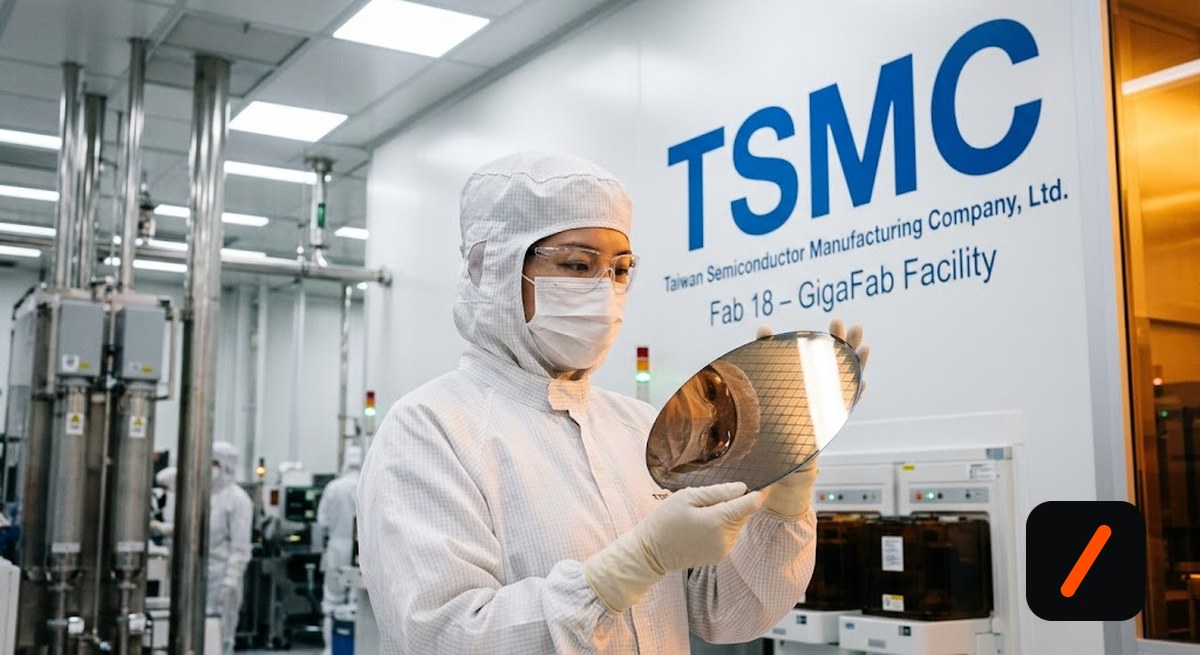
TSMC reported second-quarter net income of NT$706.56 billion, up 77.4% year over year and a record for the fifth consecutive quarter, then used the earnings call to commit another $100 billion to Arizona for at least four more chip and advanced packaging plants at 2nm and below. That lifts its total announced US investment to $265 billion. But the number that actually moved the market was smaller and less glamorous: TSMC raised 2026 capital expenditure guidance to $60-64 billion, up from $52-56 billion, mid-year, which is not something it normally does.
- Q2 revenue: NT$1.27 trillion ($40.20B), up 36% year over year, beating consensus of NT$1.264 trillion. Net income beat the NT$632.64 billion estimate by more than 11%.
- High-performance computing was 66% of revenue. That is the AI-chip bucket. Smartphones, historically TSMC's anchor, contributed 22%.
- June alone hit NT$442.68 billion, up 67.9% year over year and the highest monthly revenue in company history.
- Full-year revenue growth guidance raised to "slightly above 40%" in US dollar terms, from roughly 30% guided just a month earlier in June.
What did TSMC actually announce?
Three things, in ascending order of importance. First, the results: record profit, record June, a 36% revenue jump, and HPC at two-thirds of the business. Second, the Arizona commitment: CEO C.C. Wei told the Taipei earnings conference that TSMC will add $100 billion for at least four more fabs and advanced packaging facilities producing at 2nm and below, on top of the eight plants already announced or underway. Notably, Wei attached no timeline, saying construction pace will be set by market demand. Third, the capex raise, delivered by CFO Wendell Huang: $60-64 billion for 2026, with 70-80% going to advanced process technologies.
RelatedASML Raises 2026 Guidance Again as EUV Orders Surge
Q3 revenue is guided to $44.6-45.8 billion, up about 12% sequentially at the midpoint.
Why does the capex number matter more than the $100 billion?
Because one is a check being written and the other is a press release. The Arizona figure is large, politically useful, and explicitly untimed: "at least four more plants," pace set by demand, no completion dates. Announced US investment totals of $265 billion are a commitment to intent. Capex guidance is a commitment to spend inside 12 months, audited, with suppliers already booking the orders.
And TSMC does not normally touch capex in Q2. UBS flagged both the timing and the magnitude, noting the revision exceeded 10%, which is why it read as a genuine surprise rather than a routine tidy-up. A mid-year raise of this size says demand visibility improved materially after the budget was set. The company also lifted full-year revenue growth guidance from roughly 30% to above 40% in a single month, which is a very large revision for a company of this scale to make.
What does it mean for the market?
The signal for investors is that TSMC just removed a chunk of the "AI capex is peaking" thesis, and it did so with spending rather than commentary. The direct read-through is to semiconductor production equipment: ASML (ASML), Applied Materials (AMAT), Lam Research (LRCX) and Tokyo Electron sell into exactly the advanced-node bucket taking 70-80% of that raised budget. The corroboration matters here: ASML raised its own 2026 outlook the day before, which we covered in ASML's guidance raise, and Applied Materials' CEO has pointed to years of capacity expansion ahead. Three independent points on the same line is a trend, not a single company talking its book.
For TSMC (TSM) itself, the tension is margin: record profit and 79%-class pricing power in the memory adjacency sit against $60-64 billion of depreciation-generating spend, much of it in Arizona, where TSMC has said US fabs carry structurally higher costs than Taiwan. Watch gross margin guidance more than revenue. The broader caution is concentration: HPC at 66% of revenue means TSMC's earnings are now a leveraged bet on AI accelerator demand, and the same week delivered a chip selloff on AI-spending uncertainty. This is factual analysis, not investment advice.
| Metric | TSMC Q2 2026 | Consensus | Q2 2025 |
|---|---|---|---|
| Net income | NT$706.56B (record) | NT$632.64B | NT$398B (implied) |
| Revenue | NT$1.27T ($40.20B) | NT$1.264T | +36% YoY |
| HPC share | 66% | n/a | n/a |
| 2026 capex | $60–64B (raised) | $52–56B (prior) | n/a |
| FY revenue growth | "Slightly above 40%" | ~30% (June guide) | n/a |
| US investment | $265B announced | $165B (prior) | n/a |
Who is affected?
Equipment vendors get the cleanest benefit, and they get it first, because fab tools are ordered well ahead of the concrete. Arizona's construction and skilled-trades market absorbs another four-fab pipeline on top of eight. Nvidia, AMD, Apple and every other TSMC customer at the leading edge get a longer runway on 2nm and below capacity, which matters because N2 volume production is already sold out. And the memory side of the supply chain, already in a super-cycle, gets confirmation that the logic side is expanding to match.
RelatedApple Commits $30B to Broadcom Custom Silicon to 2031
The party least served is anyone hoping US fabs bring prices down. Wei's untimed commitment and TSMC's wafer price hikes point the same direction: capacity is being added into demand that already exceeds it, at nodes that cost more to build in Arizona than in Hsinchu. Expansion at this pace is not a discount mechanism.
- Jun 2026TSMC guides FY26 revenue growth around 30%, capex $52–56B the baseline
- Jul 15, 2026ASML raises its 2026 outlook on EUV and AI demand first corroborating signal
- Jul 16, 2026TSMC Q2: record profit, capex raised to $60–64B, +$100B Arizona the surprise
- Q3 2026Guided $44.6–45.8B revenue, up ~12% sequentially the test of the 40% full-year guide
- Does the Arizona commitment get a timeline? "At least four more plants" with pace set by demand is an intention. Groundbreaking dates would make it a plan.
- Gross margin under a $60–64B capex load. Higher US fab costs plus record spend is the one place this quarter's story could sour.
- Does equipment order flow confirm it? ASML, AMAT and LRCX bookings over the next two quarters are where a real capex raise shows up, or does not.
- HPC concentration at 66%. TSMC's earnings are now an AI-demand derivative. Any genuine slowdown in accelerator orders hits harder than it would have two years ago.
Our take
Read past the $100 billion. It is the number designed to be quoted, and it is the softest thing TSMC said all day: no timeline, no dates, pace governed by demand, on top of eight plants that are themselves not all finished. It is a real intention and it is also a headline that costs nothing to make today.
The capex raise is the actual disclosure. TSMC moved 2026 spending up more than 10% mid-year, put 70-80% of it into advanced nodes, and lifted full-year growth from 30% to above 40% inside a month. Companies do not do that on optimism; they do it because customers have committed. Combined with ASML raising its outlook 24 hours earlier and June being the largest revenue month in TSMC's history, the picture is a leading edge that is demand-constrained, not order-constrained. The risk worth naming is that the same concentration cuts both ways: at 66% HPC, TSMC has become the purest listed proxy for AI accelerator demand there is, and it is spending $64 billion against that bet.
- OfficialTSMC Investor Relations: quarterly results Q2 2026 report, capex guidance and earnings call materials
- OfficialTSMC newsroom Arizona investment announcements
- ReferenceGenZTech: ASML raises 2026 guidance the corroborating supplier signal, one day earlier
Original analysis by GenZTech. Earnings and Arizona reporting via Tom's Hardware and Investing.com.