
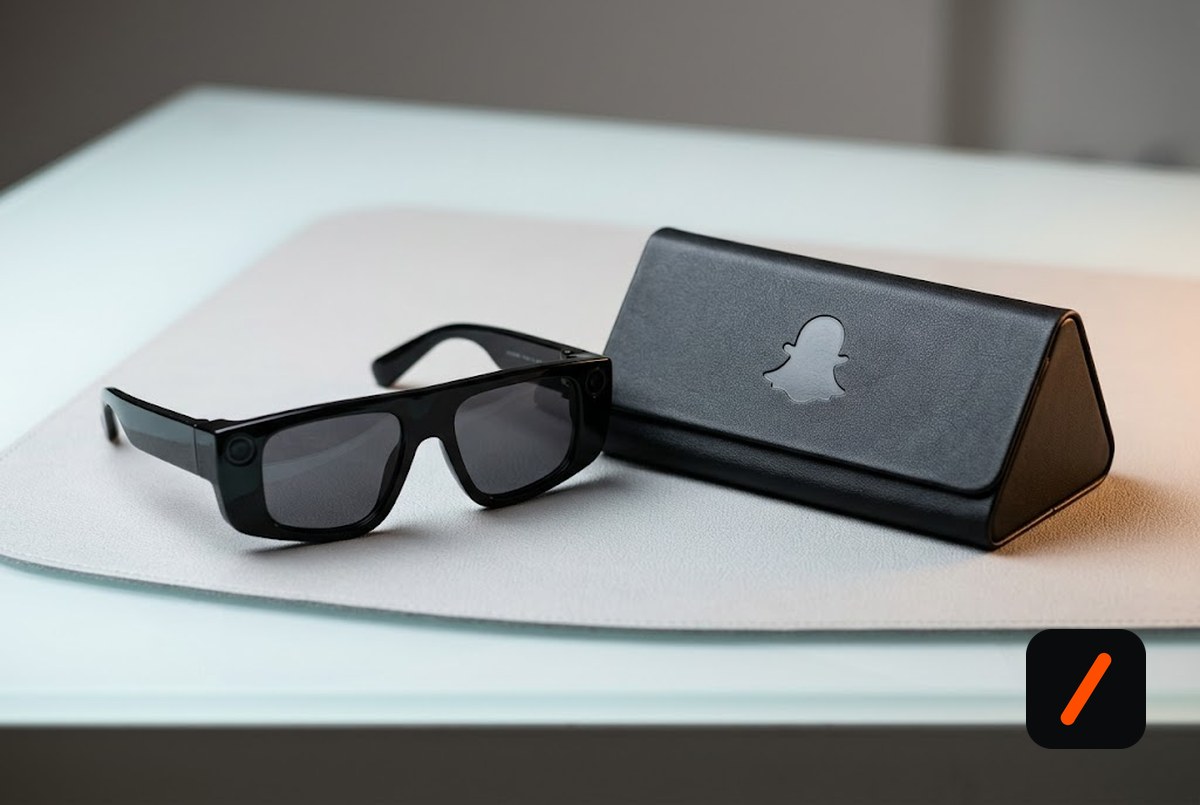
Snap thinks the next computer goes on your face, and at Augmented World Expo it put a price on that conviction. The company unveiled Specs, its first consumer augmented-reality glasses, at $2,195 and shipping this fall, running on two Qualcomm Snapdragon chips with roughly four hours of battery plus several more from the charging case. The pitch is deliberately un-Apple: rather than a heavy headset that swallows your face, Specs aim to look like glasses you would actually wear in public while overlaying AI and AR on the world in front of you. It is a real bet that lightweight, everyday smart glasses, not bulky headsets, are the device that follows the phone.
- Snap Specs are consumer AR glasses priced at $2,195, shipping this fall, unveiled at Augmented World Expo on June 16.
- They run on two Qualcomm Snapdragon chips, with about four hours of use plus four more charges from the case.
- The design bets on wearability: a glasses-like look instead of Vision Pro-style headset bulk.
- Snap is competing against Meta, Google and Apple, all chasing AI-powered smart glasses as the next platform.
What exactly are Snap Specs?
They are true augmented-reality glasses, not just camera-and-speaker glasses. The distinction matters: devices like Ray-Ban Meta capture photos, play audio and answer voice questions, but they do not project images into your field of view. Specs do, overlaying digital content onto the real world through the lenses, which is a much harder engineering problem and why they cost far more. Under the hood sit two Qualcomm Snapdragon processors to handle the compute for that AR and the AI features layered on top, and Snap has prioritized making them light and glasses-shaped rather than headset-shaped. The trade-off shows in the battery: about four hours of active use, with the case providing roughly four additional charges, which tells you these are meant for sessions and moments, not all-day continuous wear yet.
RelatedInter's Payment Ring Bets on Screenless Banking
Why price them at $2,195?
Because this is a developer-and-early-adopter device dressed as a consumer product, and the price reflects it. At more than two thousand dollars, Specs are not aimed at the mass market, they are aimed at the people who will build the apps and experiences that might one day justify a cheaper version: developers, creators and enthusiasts willing to pay to be first. That is a familiar playbook for a new computing category, seed the platform with high-priced early hardware, cultivate a software ecosystem, then ride component costs down toward a mainstream price. It still undercuts Apple's Vision Pro, and Snap is betting that a lighter, more socially acceptable form factor matters more to this audience than the raw immersion a bulkier headset delivers. The number says clearly: this is the beginning of a platform play, not a product for everyone.
| Device | Snap Specs | Ray-Ban Meta | Vision Pro |
|---|---|---|---|
| Type | Full AR glasses | Camera glasses | MR headset |
| Projects AR into view | Yes | No | Yes |
| Form factor | Glasses | Glasses | Headset |
| Price | $2,195 | ~$300+ | ~$3,500 |
| Battery | ~4h + case | Several hours | ~2h |
How does the field stack up?
Everyone with a platform ambition is chasing the same face. Meta has the lead in shipping volume with its Ray-Ban camera glasses and is pushing toward true AR; Google is weaving its AI assistant into a smart-glasses effort of its own; and Apple is reportedly developing both glasses and a pendant to complement the Vision Pro. Snap's advantage is time in the trenches, it has been iterating on Spectacles for years and has a developer community already building AR through its Lens platform, so it arrives with software momentum rather than a cold start. Its disadvantage is scale and money: Meta, Google and Apple can absorb years of losses funding a new category, while Snap is a smaller company making a large, focused bet. Specs are its statement that AR glasses, done as glasses, are worth going all-in on.
Is this the device that follows the phone?
That is the trillion-dollar question the whole industry is circling, and Specs are one serious answer, not the final one. The winners of the smartphone era believe the next general-purpose computer is something you wear, and glasses are the most plausible candidate because they sit at eye level, free your hands and can blend AI and the physical world in a way a phone in your pocket cannot. The obstacles are stubborn and physical: battery life, weight, heat, display quality and, above all, whether the software gives people a reason to wear a computer on their face all day. Four hours of battery and a $2,195 price say the technology is not there for the mainstream yet. But every mature category started with an expensive, limited first device that early adopters tolerated, and Specs are Snap planting its flag on the belief that this is that moment.
RelatedSamsung's Galaxy Able: Its First Clip-On, Bone-Conduction Buds
- The killer app. AR hardware lives or dies on software. Watch what developers actually build for Specs.
- Battery and comfort. Four hours is a session, not a day. All-day wearability is the real milestone.
- Apple and Google. How Snap's head start holds once the giants ship their own AR glasses.
- A cheaper Specs. The mainstream test is whether Snap can ride costs down to a sub-$1,000 model.
Our take
Specs are the most interesting AR device of the year precisely because Snap made the opposite bet from Apple. Where the Vision Pro maximized capability at the cost of ever leaving the house in it, Snap prioritized the thing that actually determines whether a wearable succeeds: whether you would be seen in it. That instinct is right. The history of face computers is a history of impressive headsets nobody wears, and the path to a real successor to the phone runs through hardware that looks like glasses, not goggles. The catch is that Snap has picked the hardest version of the problem, real AR in a light frame, at a price and battery life that keep this firmly in early-adopter territory. It will not be the device that puts AR on every face. But as a statement of where the category should go, and a platform to seed the software that a cheaper future model will need, Specs are a smart, and characteristically bold, move from the company that has been quietly serious about this longer than most.
- CompanySnap Spectacles the official Specs hardware and developer platform
- EventAugmented World Expo where Specs were unveiled on June 16, 2026
- ReferenceQualcomm Snapdragon the chips powering the glasses
Original analysis by GenZTech. Product details current as of July 2026. More at Snap Spectacles.